



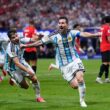


28 Red Cards were issue in FIFA World Cup held in Germany in 2006
The FIFA World Cup is the world’s premier international football tournament, organized by FIFA. It is held every four years and brings together the best national teams from around the world.
FIFA was founded on 21 May 1904 in Paris by representatives of national football associations from France , Belgium , Denmark , Netherlands , Spain , Sweden and Switzerland . Its first president was Robert Guérin, a French journalist and football administrator, not a businessman. Both FIFA and the FIFA World Cup were created by football administrators and sporting officials rather than businesspeople.
- 1904: FIFA was founded in Paris.
- 1928: FIFA voted to create the World Cup.
- 1930: The first FIFA World Cup was held in Uruguay.

The FIFA World Cup was started by Jules Rimet, a French football administrator who served as the third president of FIFA from 1921 to 1954. Why did he start the World Cup?
- Jules Rimet believed football should have an international championship open to professional players.
- Before the World Cup, football at the Summer Olympic Games was the main international competition, but it had restrictions on professionalism.
- Rimet proposed a separate global tournament under FIFA’s control.
The FIFA World Cup has been held 22 times from 1930 to 2022. The 2026 FIFA World Cup will be the first to feature 48 teams, hosted jointly by Canada, Mexico, and United States. It is the most watched sporting event in the world after the Olympic Games.

Country hosted FIFA World Cup –
| Year | Hosted by | Winner | Year | Hosted by | Winner | |
| 1930 | Uruguay | Uruguay | 1982 | Spain | Italy | |
| 1934 | Italy | Italy | 1986 | Mexico | Argntina | |
| 1938 | France | Italy | 1990 | Italy | Germany | |
| 1942 , 46 | World War | 1994 | USA | Brazil | ||
| 1950 | Brazil | Uruguay | 1998 | France | France | |
| 1954 | Switzlnd | Germany | 2002 | South Korea | Brazil | |
| 1958 | Switzlnd | Brazil | 2006 | Germany | Italy | |
| 1962 | Chile | Brazil | 2010 | South Africa | Spain | |
| 1966 | England | England | 2014 | Brazil | Germany | |
| 1970 | Mexico | Brazil | 2018 | Russia | France | |
| 1974 | Germany | Germany | 2022 | Qatar | Argntina | |
| 1978 | Argntina | Argntina | 2026 | US CAN MEX |

FIFA trophy design
The original trophy was named the Jules Rimet Trophy in honor of Jules Rimet in 1946. It was used until 1970, after which Brazil kept it permanently for winning the tournament three times. It was replaced in 1974 by the current FIFA World Cup Trophy. First Multi colour ball was used in 1998 in France World cup.
Jules Rimet Trophy –
followed a different rule:
- Any country that won it three times would keep it permanently.
- Brazil national football team achieved this by winning the World Cup in 1958, 1962, and 1970, so Brazil was awarded the Jules Rimet Trophy permanently.
FIFA World Cup Trophy Design & value –
Modern Trophy introduced in 1974, is never permanently awarded to any nation, regardless of how many times it wins the World Cup.
The FIFA World Cup Trophy is one of the most recognizable trophies in sports. It replaced the Jules Rimet Trophy in 1974.
Design
- Designer: Silvio Gazzaniga (Italy)
- Manufacturer: GDE Bertoni (Italy)
- Introduced: 1974
- Height: 36.8 cm (14.5 in)
- Weight: 6.175 kg
- Material: 18-carat gold with a base of green malachite.
- Design: Two human figures holding up the Earth, symbolizing the joy and triumph of becoming world champions.

Trophy Cost and Value
There are several ways to measure the trophy’s value:
- Original manufacturing cost (1974): Approximately US$9,390 (about US$130,000 in today’s money after inflation).
- Raw material value (gold and malachite, 2026): Around US$700,000 (approximately ₹6 crore), depending on gold prices.
- Estimated insured or symbolic value: More than US$20 million, making it one of the world’s most valuable sports trophies because of its history and prestige.
- The trophy is not awarded permanently. The original remains the property of FIFA.
- The winning team receives the trophy during the ceremony but later returns it to FIFA and keeps an official gold-plated replica.
- If the trophy were made of solid gold, it would weigh around 70–80 kg, so it is designed with a hollow structure to keep it light enough to lift.

FIFA World Cup other record –
| Year | Host | Total Teams | Total Goal | Red Card | Year | Host | Total Teams | Total Goal | Red Card | |
| 1930 | Urg | 13 | 70 | 1 | 1982 | Spn | 24 | 146 | 5 | |
| 1934 | Italy | 16 | 70 | 3 | 1986 | Mex | 24 | 132 | 8 | |
| 1938 | Fran | 16 | 84 | 5 | 1990 | Italy | 24 | 115 | 16 | |
| 42,6 | War | 1994 | USA | 24 | 141 | 15 | ||||
| 1950 | Brzil | 16 | 88 | 0 | 1998 | Fran | 32 | 171 | 22 | |
| 1954 | Swit | 16 | 140 | 3 | 02 | Kora | 32 | 161 | 17 | |
| 1958 | Swit | 16 | 126 | 1 | 06 | Ger | 32 | 147 | 28 | |
| 1962 | Chle | 16 | 89 | 9 | 2010 | SAfr | 32 | 145 | 7 | |
| 1966 | Engl | 16 | 89 | 5 | 2014 | Braz | 32 | 171 | 10 | |
| 1970 | Mexi | 16 | 95 | 0 | 2018 | Rus | 32 | 169 | 4 | |
| 1974 | Ger | 16 | 97 | 3 | 22 | Qatr | 32 | 172 | 4 | |
| 1978 | Argn | 16 | 102 | 5 | 26 | US CAN MEX | 48 | On going |

Richest footballers (estimated overall net worth)
If you consider wealth earned primarily through football and related businesses, rather than inherited family wealth, Cristiano Ronaldo is generally regarded as the richest footballer. His fortune comes from salaries, endorsements, the CR7 brand, hotels, fitness businesses, and other investments.
| Rank | Player | Estimtd net worth | Main source of wealth |
| 1 | Faiq Bolkiah | ~$20 billion | Royal family inheritance |
| 2 | Cristiano Ronaldo | ~$1.4 billion | Football, endorsements, businesses |
| 3 | Lionel Messi | ~$650–700 million | Football, endorsements, investments |
| 4 | David Beckham | ~$450 million | Football, business ventures, endorsements |
| 5 | Neymar | ~$250 million | Football, endorsements |
Cristiano Ronaldo’s one of the richest player fortune comes from multiple income streams, not just his football salary.
The major components include:
- Football salaries and bonuses
- Contracts with clubs such as Manchester United F.C., Real Madrid C.F., Juventus F.C., and Al Nassr FC.
- Match bonuses, signing bonuses, and performance incentives. His recent Al Nassr contract has been the largest contributor to his wealth.
- Endorsement deals
- Long-term partnerships with global brands, including:
- Nike , Binance , Herbalife , Tag Heuer
- These sponsorships generate tens of millions of dollars annually.
- Long-term partnerships with global brands, including:
- CR7 brand
Ronaldo owns the CR7 brand, which includes:- Clothing , Underwear , Footwear , Fragrances , Eyewear , Accessories
- Bottled water and other licensed products.
- Hotels
- He co-owns the Pestana CR7 Hotels chain with the Pestana Hotel Group, with hotels in several cities.
- Fitness and health businesses
- CR7 Fitness gyms.
- Investments in health and fitness companies such as Whoop and Bioniq.
- Real estate
- Luxury homes and apartments in Portugal, Spain, Saudi Arabia, and elsewhere.
- These properties form a significant part of his asset portfolio.
- Social media earnings
- Ronaldo has the world’s largest social media following.
- He earns substantial fees for sponsored posts on platforms such as Instagram.
- Investments
- Stakes in technology, sports, and wellness companies.
- Equity interests connected with his football career and other ventures.

Private jet –
Ronaldo owns a Bombardier Global Express XRS, acquired in 2024, replacing his earlier Gulfstream G200. The jet is custom-painted with CR7 branding and can seat around 14–19 passengers, depending on the interior configuration. It features luxury seating, a bedroom, a kitchen, Wi-Fi, and other premium amenities. Its reported value is about US$75 million.
Private Luxury Yacht –
Ronaldo owns an Azimut Grande 27 Metri motor yacht. He reportedly purchased it in 2020 for around US$7 million. The yacht is approximately 27 meters (88.5 feet) long and includes: 5 luxury cabins , 6 bathrooms , A large lounge , Dining area , Modern kitchen & Sun deck . He also own more than 40 Luxury cars. Bottom of Form

Total Goal scored – Top 6 ( up to 2022 )
The record for maximum goals in FIFA world cup up to 2022 is as below –
| Players | Country | ||||
| Name | Country | Goals | Name | Goals | |
| Klose | Germany | 16 | Brazil | 229 | |
| Nazario | Brazil | 15 | Germany | 226 | |
| Muller | Germany | 14 | Argentina | 137 | |
| Fontaine | France | 13 | Italy | 128 | |
| Lionel Messi | Argentina | 13 | France | 120 | |
| Pele | Brazil | 12 | Spain | 99 | |

FIFA world cup – Most Title won
Brazil has won the FIFA world cup 5 times
| Country | No of time Title won | Country | No of Time Title won | |
| Brazil | 5 | Argentina | 3 | |
| Germany | 4 | France | 2 | |
| Italy | 4 | Uruguay | 2 |

Red Card to Team Coach
No team manager was shown a red card in the FIFA World Cup from 1930 through 2002. This is because the formal yellow/red card disciplinary system for coaches and technical staff did not exist for much of World Cup history.
Some notable manager/head coach dismissals in recent World Cups include:
- Fernando Santos (Greece) – sent off during the 2014 Round of 16 match against Costa Rica national football team after protesting to the referee.
- Paulo Bento (South Korea) – shown a red card after the group-stage match against Ghana national football team at the 2022 FIFA World Cup for confronting the referee after the final whistle.
So, in summary:
- 1930–2002: No recorded team manager red cards.
- 2014: Fernando Santos (Greece).
- 2022: Paulo Bento (South Korea).

More than 2 Red card in a Match
Most red cards in a single World Cup match was 4 . In 2006 Word cup at Germany , Portugal 1–0 Netherlands (2006) match , Portugal received 2 red cards and the Netherlands received 2 red cards. No other team has ever had more than 2 players sent off in a single FIFA Men’s World Cup match.
| World Cup | Match | Team receiving 2 red cards |
| 1990 Final | Argentina national football team vs West Germany national football team | Argentina (Pedro Monzón and Gustavo Dezotti) |
| 2006 Round of 16 | Portugal national football team vs Netherlands national football team | Portugal (Costinha and Deco) |
| 2006 Round of 16 | Portugal vs Netherlands | Netherlands (Khalid Boulahrouz and Giovanni van Bronckhorst) |

Controversial acts in the FIFA match –
Many Controversial decisions and brawl happened during football matches.
- “Hand of God” (1986)
Diego Maradona scored with his hand against England in the quarter-final. The referee allowed the goal, and Argentina won 2–1. Maradona later described it as “a little with the head of Maradona and a little with the hand of God.” - Zinedine Zidane’s headbutt (2006 Final)
In the World Cup final against Italy, Zidane headbutted Marco Materazzi after an exchange of words. He was sent off in his final professional match, and Italy won the title on penalties. - Luis Suárez handball vs. Ghana (2010)
Suárez deliberately handled the ball on the goal line in the last minute of extra time, preventing a certain Ghana goal. He was sent off, but Ghana missed the penalty and Uruguay eventually advanced on penalties. The incident remains one of football’s most debated moments. - Frank Lampard’s disallowed goal (2010)
England’s Frank Lampard scored against Germany, but the ball clearly crossed the goal line before bouncing out. The goal was not awarded, helping Germany win 4–1. This incident accelerated the adoption of goal-line technology. - South Korea vs. Italy (2002)
South Korea defeated Italy 2–1 after extra time, but the match was overshadowed by controversial refereeing decisions, including a disputed red card for Italy and disallowed Italian goals. - The “Disgrace of Gijón” (1982)
West Germany defeated Austria 1–0 in a match where both teams appeared content to preserve a result that eliminated Algeria. FIFA later changed the rules so that final group-stage matches are played simultaneously. - Luis Suárez bites Giorgio Chiellini (2014)
Suárez bit Chiellini during a group-stage match. He received a lengthy suspension after the tournament.
These incidents have influenced the history of the tournament, leading to changes in officiating, technology, and tournament rules.

Winning Prize of FIFA world cup –
Till 1978 there was no winning prize to winning team till 1978 . The winning prize was introduced by FIFA in 1982 onward.
| Year | Cup Host | Winer | Prize in $ Million | Year | Cup Host | Winer | Prize in $ DollarMillion | |
| 1982 | Spain | Italy | 2.20M | 2006 | Germa | Italy | 20.0M | |
| 1986 | Mexic | Argent | 2.8M | 2010 | South Africa | Spain | 30 M | |
| 1990 | Italy | Germ | 3.5M | 2014 | Brazil | Germ | 35 M | |
| 1994 | USA | Brazil | 4.0 M | 2018 | Russia | Franc | 38.0M | |
| 1998 | Frnce | Franc | 6.0M | 2022 | Qatar | Argent | 42.0M | |
| 2002 | South Korea | Brazil | 8.0M | 2026 | US CAN MEX | On going | 50.0M |

Misconduct in FIFA
Over the years, FIFA has faced numerous allegations and investigations. While many officials have been convicted or sanctioned. The most significant controversies include:
1. 2015 FIFA corruption scandal (the biggest)
- U.S. and Swiss authorities investigated FIFA officials for alleged:
- Bribery
- Racketeering
- Money laundering
- Wire fraud
- More than a dozen current and former football officials and sports marketing executives were charged.
- The investigation centered on alleged bribes worth over US$150 million related to media rights and marketing contracts.
The 2015 investigations led to:
- Arrests of numerous football officials.
- Lifetime bans for several administrators.
- The resignation of Sepp Blatter as FIFA president.
- Major governance reforms intended to improve accountability and transparency.
These events are widely regarded as the most significant corruption crisis in FIFA’s history.

2. World Cup hosting vote allegations
Several World Cup host selections have been controversial:
- 2010 South Africa – allegations that votes were influenced by improper payments.
- 2018 Russia – allegations of corruption during the bidding process.
- 2022 Qatar – allegations that FIFA Executive Committee members accepted bribes in exchange for votes. Qatar has consistently denied wrongdoing,
3. Bribery involving television and marketing rights
Investigators alleged that football officials accepted millions of dollars in kickbacks in return for awarding lucrative broadcasting and commercial rights for FIFA and regional tournaments.
4. Presidential election controversies
FIFA presidential elections have also attracted allegations of vote-buying and unethical campaigning.
- Former FIFA President Sepp Blatter was suspended by FIFA’s Ethics Committee in 2015 over an improper payment to Michel Platini, although both denied wrongdoing.
Following the 2015 scandal, FIFA introduced governance reforms, including stronger ethics rules, term limits for senior officials, and greater financial disclosure. These events are widely regarded as the most significant corruption crisis in FIFA’s history.
FIFA World cup 2026 ( USA , Canada & Mexico )
FIFA world cup is being jointly hosted by Canada , Mexico and USA
Total country participating – 42
No of Matches to be played – 104
Cup winner Prize = $ 50 Million
Current status – Tournament Ongoing
Date of Final Match – 20th July 2026

Popularity of FIFA Football
Football has been popular in Europe and south America prior to Second World War. Popularity of FIFA world cup football increased after Live TV relay started in 1966 .
1986 – Coverage increased due to Colour TV coverage and sponsorship by Addidas
2002 – Revenue reached Billion Dollar driven by sponsorship deal
2006-18 – With FIFA popularity increase Revenue increase from $ 3.2 Billion to $ 6.4 Billion
2022 – FIFA world cup at Qatar was very popular with higher viewership generating $7.6 Billion
2026 – With World cup being hosted in US /Canada / Mexico , anticipated revenue is $11.0 Billion , highest so for.
FIFA fever is on in India for 2026 World cup , most of the Indian football fans are not sleeping as matches are televised at midnight in India.

Thoroughly researched and wonderfully compiled blog.🙏👍👏👏
Undoubtedly Soccer is the most interesting and one of the most favourite sports in the world.
Absolutely spot on observation , eagerly looking forward to one more sleepless night.